Key Takeaways
- Deer Management Plans help landowners manage deer impacts rather than simply reduce deer numbers.
- Effective plans start with clear land management objectives.
- Woodland Impact Assessments are often more important than population estimates.
- Management options may include monitoring, habitat protection, population management and, where the landowner chooses, fencing or tree protection measures.
- Plans should be reviewed regularly and adapted as conditions change.
- Collaborative management often delivers better results than working in isolation.
What Is a Deer Management Plan?
A Deer Management Plan (DMP) is a structured framework for understanding, monitoring and managing the impact of deer on a property.
It brings together information about local deer populations, habitat condition, land management objectives and practical interventions to create a long-term strategy that is both effective and sustainable.
At its simplest, a Deer Management Plan answers four key questions:
- What deer are present?
- What impact are they having?
- What are the objectives for the land?
- What actions are required to achieve those objectives?
In practice, a good Deer Management Plan works less like a rulebook and more like a decision-making tool. It gives a woodland owner, farmer, estate manager or conservation organisation a clear, evidence-based picture of what is happening on their land, why it is happening, and what — if anything — needs to change as a result.
For a woodland owner, this might mean understanding why a planting scheme has stalled at the same height for three years running, and whether deer browsing is the underlying cause or simply one factor among several. For a farmer, it might mean working out whether crop losses along a field margin are linked to a particular deer path, a particular time of year, or a particular species. For an estate, it might mean reconciling a sporting interest in deer with a parallel commitment to woodland creation or habitat restoration. For a conservation organisation, it might mean demonstrating — with evidence rather than assumption — that a management intervention has allowed sensitive ground flora to recover.
In each of these cases, the plan does the same underlying job: it replaces guesswork with observation, and replaces reactive decision-making with a considered, repeatable process. Rather than responding to each new instance of damage in isolation, the landowner has a framework for asking whether the damage fits a wider pattern, whether it is getting better or worse, and whether the current approach is actually working.
While deer remain an important and valued part of the British countryside, deer populations across the United Kingdom have increased significantly over recent decades.
Estimates suggest the national population has risen from around 450,000 deer in the 1970s to more than two million animals today.
As deer numbers and distribution have expanded, so too has the pressure they exert on woodlands, agricultural land, conservation sites and newly established planting schemes.
For many landowners, the challenge is not the presence of deer itself. The challenge arises when deer impacts become incompatible with wider land management objectives.
A woodland owner seeking natural regeneration may find that young trees never progress beyond the sapling stage. A farmer may experience repeated crop losses from browsing and trampling. A conservation organisation may discover that important ground flora and woodland understory species are disappearing.
In each case, the issue is not necessarily how many deer are present, but the effect they are having on the habitat. This distinction is important.
Modern deer management is increasingly focused on managing impacts rather than simply reducing deer numbers. A successful Deer Management Plan aims to achieve a balance between maintaining healthy deer populations and protecting the environmental, agricultural, forestry and conservation interests of the land.
This is also why deer management planning tends to work best as an ongoing process rather than a fixed set of instructions written once and left unchanged. Conditions on the ground rarely stay the same for long, and a plan that is built with review and adjustment in mind from the outset is far more likely to remain useful — and effective — over time.
A well-constructed Deer Management Plan provides a clear evidence base for management decisions. It creates a record of observations, identifies measurable objectives and establishes a framework for monitoring progress over time.
Whether managing a small private woodland, a commercial forestry holding, a mixed farming enterprise or a large rural estate, a Deer Management Plan provides the foundation for informed, responsible and effective deer management — see why deer management matters for landowners for wider context.
Why Deer Management Has Become Increasingly Important
The UK is experiencing the highest deer population levels recorded in modern times.
Several factors have contributed to this growth, including:
- Increased woodland cover
- Milder winters
- Improved food availability
- Expansion of winter crops
- The spread of non-native species
- An absence of natural predators
Today, six species of wild deer occur within the UK: Roe Deer, Red Deer, Fallow Deer, Muntjac Deer, Sika Deer and Chinese Water Deer. Our guide to deer species in Sussex looks at how to identify each one and the impacts typically associated with it.
None of these factors are problems in themselves. A landscape that supports a healthy deer population is, in many respects, a sign of a functioning countryside. The difficulty is one of balance — and in many parts of the UK, that balance has shifted to the point where deer pressure is now a routine consideration in woodland management, farm planning, forestry operations and conservation work, rather than an occasional concern.
Woodland Regeneration
One of the most visible consequences of excessive deer pressure is the failure of woodland regeneration. Young trees are highly palatable to deer.
Repeated browsing can prevent seedlings and saplings from reaching maturity, creating woodlands with ageing canopies but little natural replacement beneath them.
Over a long enough period, this can leave a woodland structurally unbalanced — dominated by mature trees with no younger cohort coming through to replace them as they age, fall or are felled. For woodland owners with long-term regeneration or restocking objectives, this is often the single clearest reason to consider a structured approach to woodland deer management, since the effects of inaction tend to compound over successive growing seasons rather than remain static.
Biodiversity Impacts
Heavy browsing pressure can remove woodland shrubs, wildflowers and ground flora that provide habitat for birds, insects and small mammals.
Over time, this can alter the structure and ecological function of entire woodland ecosystems — a pattern explored further in our guide to deer damage to woodland.
A woodland that has lost its shrub layer and ground flora to sustained browsing pressure can look superficially healthy from a distance — the canopy may still be intact — while supporting markedly less wildlife and a far simpler structure underneath. This is one of the reasons biodiversity decline linked to deer pressure can go unnoticed for a number of years: the change is gradual, and the most visible layer of the woodland is often the last to be affected.
Agricultural Damage
Deer can cause substantial economic losses through crop browsing, grazing pressure, trampling, damage to horticultural crops and losses within young planting schemes. Our guide to deer damage to agriculture looks at these impacts in more detail.
For many farms, the financial impact is concentrated in particular fields, particular crops or particular times of year — often where land borders woodland, scrub or other deer cover. Identifying these patterns is usually more useful than estimating an overall loss figure, because it points directly towards where management effort is best targeted.
Forestry Losses
Commercial forestry operations may experience browsing damage, bark stripping, reduced timber quality, delayed crop establishment and increased protection costs.
These losses are not always immediately visible in the way that a damaged crop or a fallen fence might be. A delay in establishment, a reduction in stem quality, or an increase in the cost of protecting a planting scheme can all represent a significant cumulative cost over the life of a forestry rotation, even where no single incident looks especially serious in isolation.
Public Safety
Thousands of deer-vehicle collisions occur across the UK every year, resulting in injuries, vehicle damage and animal welfare concerns.
For estates and landowners with roads, tracks or public access running through or alongside their land, deer movement patterns can also be a relevant safety consideration — particularly around dawn and dusk, when deer are most active and visibility is often reduced.
For all of these reasons, structured deer management has become an increasingly important component of woodland management, farming, conservation and environmental stewardship. A considered deer control strategy — grounded in evidence rather than guesswork — helps landowners respond to these pressures in a proportionate and sustainable way, rather than reacting piecemeal to each new sign of damage as it appears.
When Should You Consider a Deer Management Plan?
A Deer Management Plan is most effective when developed before impacts become severe. Many landowners first begin thinking seriously about deer management after noticing a cluster of small, seemingly unconnected issues — a planting scheme that is not establishing as expected, a field margin that keeps getting grazed back, a woodland ride that always seems to have fresh tracks across it. Individually, each of these might be dismissed. Together, they often point towards a wider pattern worth investigating properly.
Common indicators include:
Browse Lines
A browse line is one of the clearest visual signs of sustained deer pressure — a distinct horizontal line at the height deer can comfortably reach, above which foliage remains intact and below which it has been repeatedly grazed away. Where a browse line is visible across a wide area of woodland or hedgerow, it is usually a sign that deer pressure has been consistent over a number of seasons rather than a one-off event.
Failed Sapling Establishment
Seedlings appearing each year but never progressing to sapling stage is one of the most reliable indicators of unsustainable browsing pressure. It is worth checking not just whether young trees are present, but whether the same individuals are still there — and growing — a year later.
Bark Stripping
Bark stripping and fraying on standing trees can indicate which species are present and how intensively they are using a particular area. Repeated damage on the same trees, or damage concentrated along certain rides or stand edges, often reflects a regular pattern of use rather than a chance encounter.
Crop Damage
Recurring losses in the same fields, along the same margins, or to the same crops at the same time of year usually indicate an established pattern of deer activity rather than an isolated incident — and patterns of this kind are exactly what a Deer Management Plan is designed to identify and address.
Heavy Deer Paths
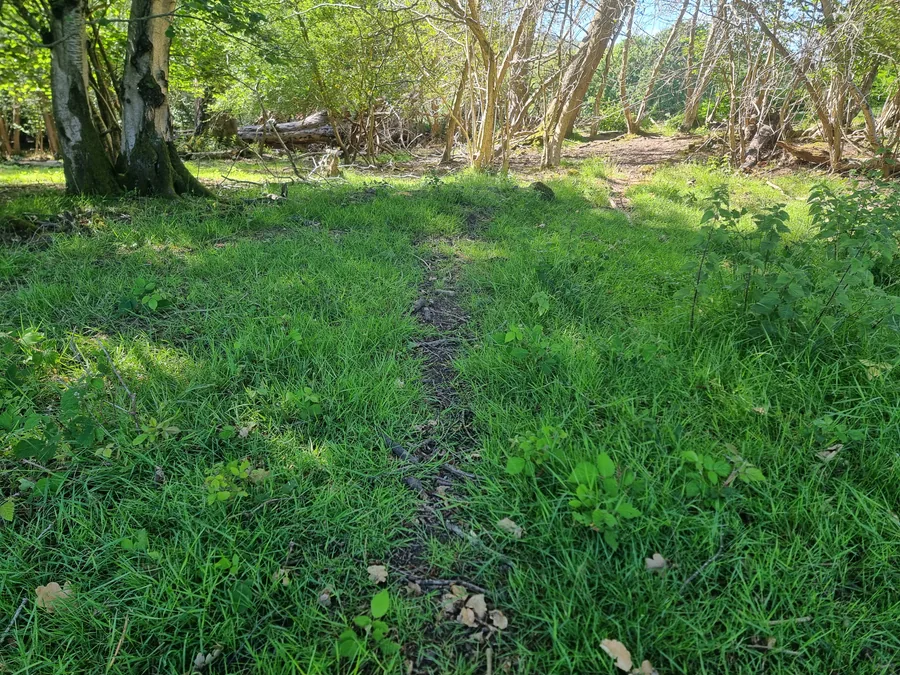
Well-defined trails through woodland, hedgerows or field margins — sometimes called deer runs — show where animals are moving regularly between cover, feeding areas and water. Their location, direction and condition can offer a useful, low-cost source of evidence about how deer are using a property.
Repeated Sightings at Dawn and Dusk
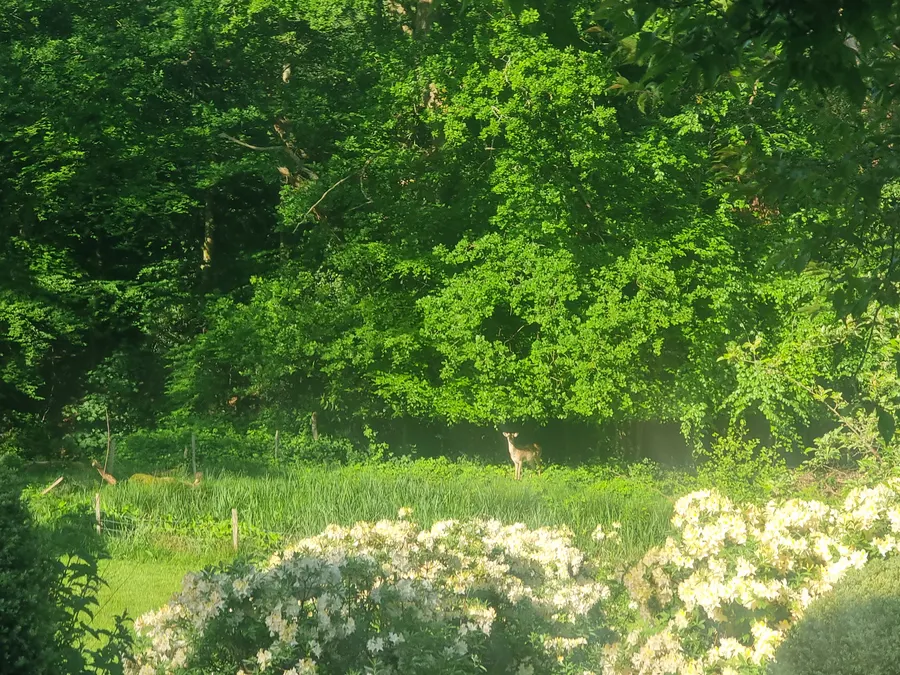
Deer are most active around first and last light. Regular sightings at these times — particularly in the same locations — can help build a picture of which areas are most heavily used, and at what times of day management activity might be most relevant.
Loss of Understory Vegetation
A woodland floor that is becoming progressively more open, with fewer shrubs, less ground flora and a simpler overall structure, is often among the strongest long-term indications that deer pressure is exceeding what the habitat can sustain.
Conservation Concerns
The disappearance of sensitive plant species or declining habitat quality may indicate unsustainable deer impacts, particularly where these changes coincide with other signs from the list above.
None of these signs need to be present in isolation to justify a closer look. In practice, most landowners who go on to develop a full Deer Management Plan have noticed a combination of two or three of these indicators over a period of time — which is usually a strong enough signal that a more structured assessment is worthwhile.
Step 1: Define Your Management Objectives
Every successful Deer Management Plan starts with a simple question: what are you trying to achieve?
It is tempting to skip straight to the question of deer numbers — how many are out there, and how many should be removed. But without a clear sense of what the land is for, that question has no real answer. A density of deer that would be entirely sustainable on one property could be wholly incompatible with the objectives of another. Objectives come first; everything else in the plan follows from them.
Objectives will vary considerably between properties, and often between different parts of the same property. Some examples of how this plays out in practice:
- Woodland regeneration — where the priority is to allow seedlings and saplings to establish naturally, the plan needs to focus closely on browsing pressure in regeneration areas, and on whether young trees are surviving long enough to grow beyond the height deer can reach.
- Commercial forestry — where timber quality, establishment rates and protection costs are the central concern, the plan needs to weigh up fencing, tree shelters and population management against the practical costs and timescales of a forestry rotation.
- Agricultural protection — where the goal is to reduce crop losses and protect specific fields or enterprises, the plan needs to identify which areas are most affected, at which times of year, and by which species.
- Biodiversity recovery — where the aim is to allow ground flora, shrubs and associated wildlife to recover, the plan needs to set out how progress will be measured — for example through fixed-point photography or exclosure comparisons — so that recovery can be demonstrated rather than assumed.
- Sporting estates — where deer form part of a sporting interest as well as a management consideration, the plan needs to balance the maintenance of a healthy, well-managed population with the wider habitat and land management objectives of the estate.
- Mixed-use rural estates — where forestry, farming, conservation and sporting interests sit alongside one another, the plan needs to reconcile what can sometimes be competing priorities, and set out a sensible order in which to address them.
Unclear objectives are one of the most common reasons deer management efforts fail to deliver lasting results. Without a defined goal, it becomes very difficult to judge whether an action — fencing a block of woodland, increasing the cull, changing where feed is placed — has actually worked. Management can end up being driven by whatever issue feels most pressing at the time, rather than by a coherent long-term plan, and effort can be spent in places that do little to advance what the landowner is actually trying to achieve.
Management actions should always be driven by clearly defined objectives rather than arbitrary population targets.
Step 2: Assess Deer Impacts
Many landowners focus on how many deer they see. In practice, the more important question is: what effect are those deer having on the land?
This distinction matters because population numbers on their own tell you relatively little about whether your objectives are at risk. A wood that supports a modest number of deer can show severe signs of browsing pressure if the habitat is sensitive or the deer are concentrated in a small area. Conversely, a much larger population spread across an extensive landscape may have comparatively little effect on any single block of woodland. A Deer Impact Assessment — a structured look at the evidence on the ground — is usually a far more useful starting point than an attempt to count animals.
A thorough assessment may draw on several different methods, each contributing a different kind of evidence:
Browsing Assessments
A browsing assessment looks systematically at the condition of vegetation across a site, recording where and how severely it has been affected. This typically includes:
- Damaged saplings
- Browsed leader shoots
- Suppressed regeneration
- Loss of understory vegetation
Recording these observations consistently across a site — and repeating the exercise over time — turns a series of individual impressions into a body of evidence that can support real management decisions.
Natural Regeneration Assessments
Natural regeneration assessments look specifically at whether young trees are establishing and progressing through successive age classes. Questions to consider include:
- Are seedlings present?
- Are saplings surviving?
- Are young trees progressing through age classes?
Where seedlings are visible each year but never seem to grow taller, this usually points towards a recurring cycle of germination and browsing rather than a lack of seed source — an important distinction when deciding what action, if any, is needed.
Bark Stripping Assessments
Bark stripping assessments record the extent and pattern of damage to standing trees. Useful information to gather includes:
- Extent of damage
- Species affected
- Distribution across the property
Because bark stripping and fraying behaviour differs between species, this kind of assessment can also help build a clearer picture of which deer are present and how they are using the site — complementing the population information gathered in Step 3.
Ground Flora Assessments
Ground flora assessments look at plant diversity, woodland structure and habitat quality at ground level — the layer most sensitive to sustained browsing pressure, and often the first to show signs of change.
Fixed Point Photography
Fixed point photography involves photographing the same location, from the same position, at regular intervals. Over time, this builds a visual record of how a site is changing — making it possible to see gradual shifts in vegetation cover, regeneration and structure that would be very difficult to judge from memory alone.
Exclosures
An exclosure is a small fenced area that excludes deer from a defined patch of habitat. Comparing vegetation inside and outside the exclosure over time provides one of the clearest possible demonstrations of what deer browsing is — and is not — responsible for, and is a useful diagnostic also discussed in our guide to deer damage to woodland.
Taken together, these methods build something far more useful than a population estimate: a body of evidence that shows what is actually happening on the ground, where it is happening, and whether it is getting better or worse over time. This is why impact evidence is generally more valuable than a deer count when it comes to making real management decisions — it tells you not just that deer are present, but whether their presence is compatible with what you are trying to achieve.
Step 3: Understand Local Deer Populations
The objective is not necessarily to establish an exact population figure. Instead understand which species are present, where they occur, how they use the landscape and how behaviour changes throughout the year.
This matters because different deer species behave differently, browse at different heights, favour different habitats and respond differently to management. A plan built around the wrong assumptions about which species are present — or how they behave — is unlikely to deliver the results a landowner is hoping for. Some practical, landowner-relevant points on each UK species:
- Roe deer — widespread across Sussex and much of lowland Britain, roe deer are typically solitary or seen in small family groups, favour woodland edges and field margins, and browse at relatively low heights. They are often the species most associated with damage to young trees, hedgerows and field-edge crops on smaller and medium-sized properties.
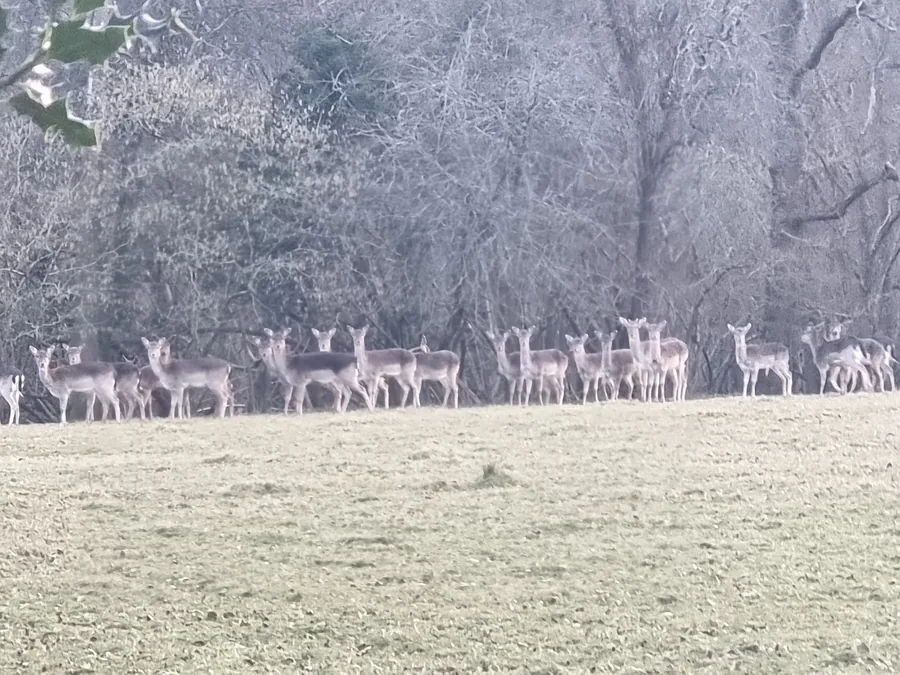
- Fallow deer — also common across Sussex, fallow deer are gregarious and often move in herds, which can mean concentrated pressure on particular areas of woodland or farmland. They browse higher than roe deer and are one of the species most associated with bark stripping on vulnerable trees.
- Muntjac deer — a smaller, non-native species now well established across Sussex and much of southern England, muntjac browse close to the ground and can be active throughout the year rather than following a strongly seasonal pattern. They are frequently linked to damage in woodland understorey, coppice regrowth and garden or smallholding planting.
- Red deer — the UK's largest native deer species, more strongly associated with upland and northern landscapes, but present in some lowland areas including parts of southern England. Where present, their size and herd behaviour mean their impact on vegetation and infrastructure can be significant.
- Sika deer — present in scattered populations across parts of the UK, sika can be difficult to distinguish from red deer at a distance and are known for bark stripping behaviour similar to fallow deer in some circumstances. Where sika are present, accurate species identification becomes particularly important.
- Chinese water deer — a smaller, antler-less species found mainly in parts of eastern and central England, less commonly encountered in Sussex but worth understanding where properties sit within or near their established range.
For landowners in Sussex specifically, roe, fallow and muntjac are by far the species most likely to be encountered, and most likely to be the focus of a Deer Management Plan. Understanding which of these — or which combination of these — is present on a given property is among the most useful things a landowner can establish, because it shapes almost every decision that follows: where to focus monitoring, what kind of protection is likely to be effective, and what realistic outcomes look like.
Monitoring methods may include direct observation, trail cameras, thermal surveys, deer counts and field sign assessments. None of these methods needs to be used in isolation — in most cases, a combination built up gradually over a season or more provides the clearest overall picture.
Step 4: Select Appropriate Management Actions
Once objectives are clear and impacts have been assessed, the plan can move on to the practical question of what to do about it. In most cases, the right answer is not a single measure but a combination of approaches, chosen to suit the objectives, the habitat, the species present and the resources available.
Deer Fencing
Deer fencing can protect woodland creation projects, natural regeneration areas and sensitive habitats. It can be highly effective where the area to be protected is well defined, but it represents a significant capital cost, requires ongoing maintenance, and needs to be planned with an eye to the landscape as a whole — fencing one area can sometimes simply redirect deer pressure elsewhere on the property.
Tree Shelters
Tree shelters offer a more targeted form of protection for vulnerable young trees, and are often a practical option where smaller-scale or more flexible protection is required than a full fencing scheme would justify. They work best as part of a wider strategy rather than as a stand-alone solution, particularly where deer pressure is high.
Habitat Management
Habitat management — including ride management, woodland edge management and strategic planting — can help reduce pressure on the most sensitive areas by improving the overall quality and distribution of food and cover available to deer across a site. This kind of work often complements other measures rather than replacing them, and can support wider biodiversity objectives at the same time.
Daytime Deer Control
Where impacts are significant, population management may form part of the strategy, and daytime control is often the starting point. Its effectiveness depends on factors such as deer behaviour, terrain, visibility and the level of disturbance on a site, and it forms one part of a wider, balanced deer control strategy rather than a complete solution on its own.
Night-Time Deer Control
In some circumstances deer become increasingly nocturnal, making daytime management less effective — particularly where disturbance levels are high or deer have learned to avoid areas of human activity during the day.
Natural England's CL55 licence may provide an additional management tool in certain situations and subject to the relevant legal requirements. Where it is relevant, it tends to form one element within a wider, carefully considered strategy, rather than a measure used in isolation — and any landowner considering it should seek up-to-date guidance on the specific legal requirements that apply to their situation.
Collaboration
Deer do not recognise ownership boundaries. A herd that spends part of its time on a neighbour's land may be responsible for much of the impact seen on yours, and management carried out in isolation can sometimes simply shift pressure from one property to another rather than reducing it overall. Working collaboratively with neighbouring landowners — sharing observations, coordinating timing, or aligning broader objectives — often improves outcomes for everyone involved, and can make the difference between a plan that delivers lasting change and one that produces only a temporary, local effect.
Step 5: Set Targets and Review Progress
Examples of measurable targets include:
- Increased natural regeneration
- Reduced browsing pressure
- Reduced bark stripping
- Improved habitat condition
- Reduced crop losses
Setting targets is only half the process — the other half is reviewing progress against them on a regular basis, typically through an annual review. An annual review gives a landowner a natural point in the calendar to step back, look at what has changed since the last assessment, and decide whether the current approach is working or needs to be adjusted.
Monitoring trends over several seasons is usually far more informative than looking at any single year in isolation. A poor year for regeneration, for example, might reflect a particularly hard winter, a change in deer movement, a run of dry weather, or simply natural variation — and it can be difficult to know which without a longer run of comparable evidence to look back on. Trends, by contrast, tend to reveal whether a genuine, lasting change is taking place.
Where the evidence shows that targets are not being met, the plan should be flexible enough to allow management actions to be adjusted — whether that means changing where and when control takes place, reconsidering fencing or protection measures, revisiting habitat management priorities, or simply allowing more time for an approach to take effect. Equally, where the evidence shows clear progress — habitat recovering, regeneration improving, losses reducing — that is valuable confirmation that the current approach is working and worth continuing.
This is also why a Deer Management Plan should be treated as a living document rather than a one-off exercise. Vegetation recovers or declines, deer move into new areas, weather and habitat conditions vary from year to year, and a plan that is reviewed and updated regularly is far more likely to remain genuinely useful — and to keep delivering results — than one that is written once and left to gather dust.
Deer Management Plans for Different Landowners
While the underlying process — define objectives, assess impacts, understand populations, select actions, review progress — remains the same, the detail of a Deer Management Plan looks quite different depending on the kind of property it covers and what the landowner is ultimately trying to achieve.
Woodland Owners
Woodland owners are typically focused on regeneration, biodiversity and long-term woodland resilience. A plan for this kind of property often centres on browsing assessments in regeneration areas, monitoring of natural recruitment through successive age classes, and decisions about where fencing, tree shelters or targeted control will have the greatest effect. A common objective is simply to give the next generation of trees a realistic chance to establish — see our guide to woodland regeneration and deer browsing for more detail on how this process works in practice.
Farmers
Farmers are usually focused on crop protection and reducing economic losses. For this group, a plan often concentrates on identifying which fields, crops and times of year are most affected, understanding how deer are moving onto agricultural land from adjacent woodland or cover, and weighing up the practical costs and benefits of measures such as fencing, changes to cropping patterns near vulnerable margins, or population management where losses are persistent and significant.
Estates
Estates often need to balance conservation, forestry and sporting interests — objectives that can pull in different directions if they are not considered together. A plan for an estate typically needs to set out how these priorities will be reconciled: for example, how a sporting interest in maintaining a healthy deer population can sit alongside a parallel commitment to woodland regeneration or habitat restoration, and how decisions in one area will be weighed against their effect on the others.
Conservation Organisations
Conservation organisations are generally focused on supporting habitat restoration and biodiversity objectives, often across sites with particular ecological sensitivities. For this group, a plan tends to place strong emphasis on evidence — ground flora assessments, fixed-point photography, exclosure comparisons — both to guide decisions and to demonstrate, clearly and objectively, that an intervention has achieved what it set out to achieve. For wider guidance on what a structured approach can look like, see our overview of deer management for landowners.
Common Mistakes in Deer Management Planning
Even well-intentioned deer management efforts can fall short of expectations. In our experience, the same handful of issues tend to come up again and again — and recognising them early can save a great deal of wasted time and effort.
- Focusing only on deer numbers. A population estimate on its own says very little about whether your objectives are at risk. The more useful question is always what effect deer are having on the land — which is why a proper Deer Impact Assessment matters more than a headline figure.
- Acting without clear objectives. Without a defined goal, it is very difficult to judge whether any given action is working — or even whether it is the right action to be taking in the first place. Objectives should always come before management decisions, not after them.
- Ignoring neighbouring land. Deer move freely across boundaries, and a plan that only considers what is happening within the property line can end up missing much of the picture — or addressing only part of a problem that, in reality, spans several ownerships.
- Relying only on fencing. Fencing can be highly effective in the right circumstances, but it is rarely a complete answer on its own. Used in isolation, it can simply redirect pressure elsewhere, and it does nothing to address the underlying scale of the local population if that is the root cause.
- Failing to monitor results. Without consistent monitoring — browsing assessments, fixed-point photography, exclosure comparisons or similar — it becomes very difficult to know whether a management action has actually worked, or whether any apparent change is simply down to normal year-to-year variation.
- Reviewing too infrequently. Conditions on a property rarely stay the same for long. A plan that is written once and never revisited will gradually drift away from the reality on the ground — which is why regular, ideally annual, review is such an important part of the process.
Avoiding these pitfalls is largely a matter of keeping the underlying principle in view: a Deer Management Plan is not simply about reducing deer numbers. It is about managing deer impacts in line with clear land management objectives — consistently, on the basis of evidence, and over the long term.