The problem arises when deer pressure becomes high enough to prevent young trees, shrubs and ground flora from establishing. Over time, this can change the structure of a woodland and reduce its resilience.
For landowners and woodland managers, recognising deer damage early is important. Many impacts build gradually and may not be obvious until regeneration has already been affected.
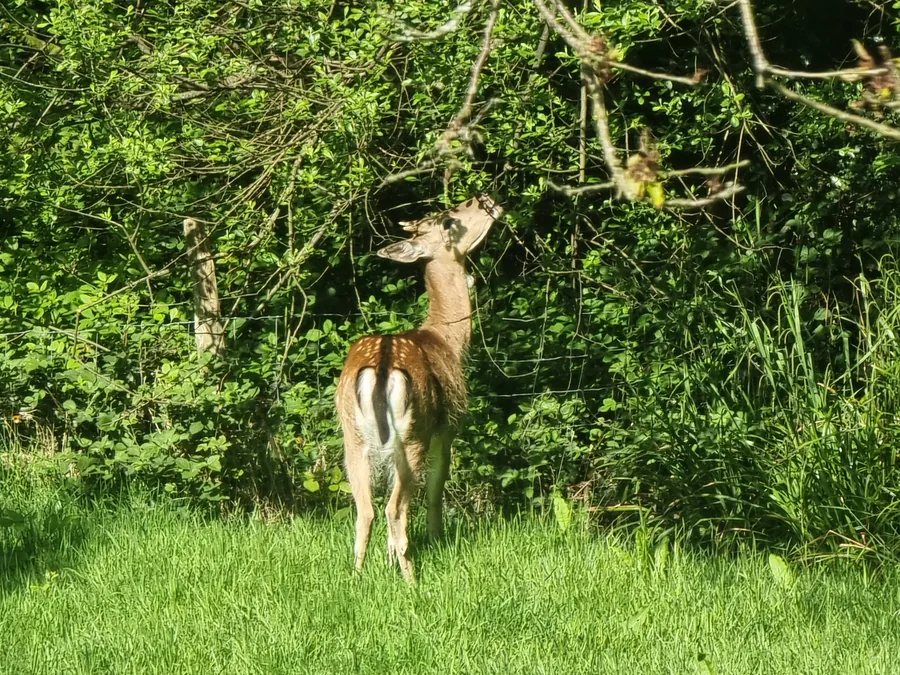
Browsing of Young Trees
Browsing damage is visible across most woodland types where deer are present in significant numbers.
Deer feed on the young shoots, buds and leaves of trees and shrubs. Browse height varies by species: roe deer typically browse below around 0.7 to 0.8 metres, while fallow can reach up to 1.8 metres or more. Muntjac browse close to the ground, targeting understorey shrubs, bramble, ground flora and the lower stems of saplings. Where multiple species share a woodland, the entire accessible height range can be under simultaneous pressure. Understanding which deer species are present helps interpret the pattern of damage accurately.
Signs include:
- Browsed leading shoots
- Uneven sapling growth
- Young trees with a clipped appearance
- Repeated damage at similar heights
- Poor survival of newly planted trees
Where browsing continues over several seasons, the woodland may lose its next generation of trees.
Loss of Woodland Understorey
A healthy woodland usually has several layers: mature trees, younger trees, shrubs, ground flora and deadwood habitat.
High deer pressure can simplify this structure. Shrubs may disappear, young trees may fail and the woodland floor may become increasingly open.
This matters because the understorey supports birds, insects, small mammals and other wildlife. It also contributes to the woodland's ability to regenerate naturally.
Failed Natural Regeneration
Natural regeneration occurs when trees establish from seed rather than being planted.
Where deer pressure is high, seedlings germinate but are browsed back before they can establish. The woodland floor may show seedlings at ground level in autumn while, by the following season, few or none have survived to even hand height. This pattern — germination without establishment — is a key diagnostic sign when assessing deer pressure in a woodland.
A practical check is to compare regeneration inside and outside any existing fenced areas or deer exclosures on the site. Where young trees establish freely inside a fence but consistently fail outside it, deer pressure is almost certainly the primary cause. For a fuller picture of how deer affect the regeneration process, see the guide to woodland regeneration and deer browsing.
Damage to New Planting
Newly planted trees are often vulnerable to deer browsing, particularly if protection is inadequate or deer numbers are high.
Tree guards and fencing can help, but they are not always sufficient on their own. If deer pressure is intense, guards may be damaged, planting lines may be repeatedly targeted and survival rates may fall.
Where planting repeatedly fails, deer impact should be assessed alongside other factors such as drought, weeds, soil condition and maintenance.
Bark Damage and Fraying
Bark damage and fraying are distinct from browsing and can provide useful information about which deer species are active in a woodland.
Fraying occurs when male deer rub velvet from their antlers against stems. Roe bucks tend to fray thin stems of roughly thumb thickness, working low to the ground and leaving a characteristically shredded or twisted stem with bark stripped in narrow ribbons. Fallow bucks fray larger stems more forcefully, at a greater height, and the damage is often more severe. The height, stem size and appearance of fraying can all help identify which species is responsible.
Bark stripping is a separate behaviour associated primarily with fallow and sika deer, where the animal bites and peels bark from standing trees, sometimes girdling the stem entirely. This can kill young trees outright and creates entry points for disease in older ones.
Both fraying and bark stripping damage is often found in consistent locations: along woodland rides, at stand edges and on well-used routes between cover and feeding areas. These locations are worth checking when assessing the extent of deer activity across a site.
Impact on Biodiversity
Deer damage is not only a forestry issue. It can also affect biodiversity.
When deer reduce the understorey and ground flora, they change the habitat available for other species. Birds, butterflies, insects and woodland plants can all be affected by the loss of vegetation structure.
Responsible deer management can therefore form part of wider conservation, habitat restoration and biodiversity work.
When Woodland Owners Should Act
Woodland owners should consider seeking advice where there is:
- Poor regeneration
- Repeated browsing
- Damage to young trees
- Loss of shrub layer
- Failed restocking
- Heavy deer activity
- Pressure on coppice regrowth
- Conservation habitat decline
Good deer management seeks a sustainable balance — one where deer remain part of the woodland ecosystem, but at a density the woodland can sustain without long-term structural decline. Where damage is established, a Deer Management Plan can help set out clear objectives and a practical course of action.
Need Woodland Deer Management Advice?
If deer are affecting woodland regeneration, planting or habitat condition, UK Deer Management can help assess the site and recommend practical management options.